Air Freight vs. Ro-Ro Shipping for Vehicles: Which is Better?
In the highly competitive landscape of global trade and international logistics, selecting the optimal transport architecture is a critical determinant of supply chain success. When enterprises, automotive manufacturers, or specialized logistics coordinators need to mobilize vehicles across continents, the decision-making process typically involves balancing two primary operational metrics: time and capital expenditure.
While containerized ocean transport is a standard consideration, the most striking operational contrast exists between the extreme velocity of air freight and the highly scalable efficiency of specialized maritime transport. Understanding the specific advantages, structural limitations, and economic implications of air freight vs. Ro-Ro shipping is essential for executing a flawless global deployment strategy. This comprehensive analysis evaluates both methodologies to determine which framework best aligns with specific commercial and industrial requirements.
The Fundamentals of Vehicle Logistics
Transporting rolling stock—whether a single prototype hypercar or a commercial fleet of heavy-duty trucks—requires specialized infrastructure that standard freight networks cannot support. Vehicles are high-value, physically large, and dynamically sensitive assets. The logistics protocol chosen must account for physical dimensions, weight distribution, securing methodologies, and the final delivery deadline.
To determine the most appropriate routing, supply chain managers must conduct a rigorous assessment of the cargo's profile. An urgent, high-stakes delivery demands a fundamentally different logistical approach than a scheduled, high-volume commercial distribution.
How Air Freight Works for Vehicles
Air freight represents the absolute apex of logistical velocity. Moving a vehicle via cargo aircraft involves specialized aviation protocols and highly restricted operational parameters.
Vehicles are typically transported in massive wide-body freighter aircraft, such as the Boeing 747-8F or the Antonov An-124. Prior to loading, the vehicle must be driven onto a specialized aviation pallet (a rigid structural platform). It is then meticulously secured using aviation-grade heavy-duty straps to withstand the immense G-forces experienced during takeoff, turbulence, and landing. Once secured to the pallet, heavy airport cargo loaders hoist the entire platform and maneuver it through the aircraft's nose or side cargo doors.
Due to strict aviation safety regulations, vehicles must be thoroughly purged of hazardous materials. Fuel tanks must be nearly completely drained (usually containing less than an eighth of a tank), and all battery terminals are strictly isolated to eliminate any risk of electrical fire at high altitudes.
How Ro-Ro Shipping Works for Vehicles
Conversely, Roll-on/Roll-off (Ro-Ro) transport is the backbone of global commercial automotive logistics. Rather than relying on pallets and lifting mechanisms, this methodology treats the maritime vessel as an expansive, multi-level, floating parking structure.
As detailed in comprehensive analyses of what is Ro-Ro shipping, the defining characteristic of this method is the drive-on/drive-off protocol. Vehicles are driven directly from the terminal dock onto the vessel via heavy-duty internal ramps. They are stowed within fully enclosed, climate-managed steel decks and secured directly to the ship’s structural lashing points. This horizontal loading mechanism eliminates the need for expensive port cranes and mitigates the structural stress associated with vertical lifting, ensuring a seamless and efficient terminal operation.
Key Comparisons: Air Freight vs. Ro-Ro
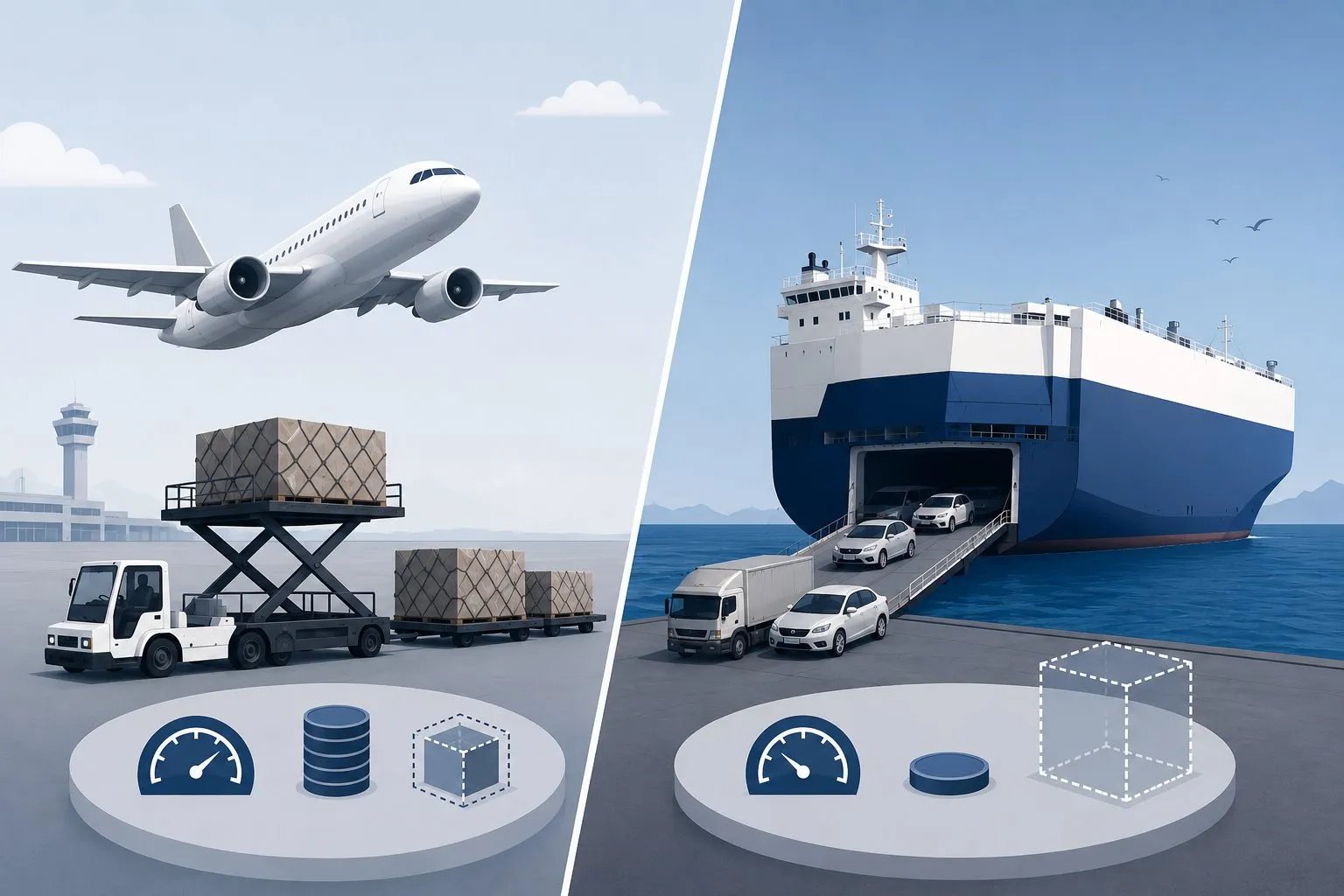
To objectively determine which transport method is superior, one must evaluate them across four critical operational benchmarks: transit speed, financial expenditure, cargo volume scalability, and physical risk management.
1. Speed and Transit Times
If time is the solitary metric of success, air freight is unmatched. A transoceanic flight that takes 12 to 15 hours can accomplish what takes a maritime vessel multiple weeks. Factoring in pre-flight customs clearance and destination unpalletizing, a vehicle can realistically be relocated across the globe within 3 to 7 days.
In contrast, Ro-Ro shipping operates on a maritime schedule. Depending on the global routing, ocean transit times generally range from 12 to 30 days, not including terminal handling and customs dwell times. Therefore, for time-critical deployments—such as international motorsport events, urgent prototype testing, or rapid deployment of diplomatic vehicles—air transport offers an insurmountable speed advantage.
2. Cost and Freight Expenditures
The velocity of air freight comes at an extreme financial premium. Aviation fuel costs, severe weight restrictions, and the specialized labor required for palletizing make air transport exponentially more expensive than any maritime alternative. Shipping a single standard passenger vehicle via air can easily cost five to ten times more than maritime transport.
Ro-Ro shipping is universally recognized for its unparalleled cost-efficiency. By capitalizing on massive economies of scale and streamlining terminal operations (completely eliminating crane usage and container stuffing), it drastically reduces baseline freight expenditures. For B2B enterprises focused on preserving capital and optimizing logistics budgets, maritime transport is the only economically viable solution.
3. Volume and Scalability
The limitations of aircraft cargo holds present significant constraints for commercial supply chains. Air freight is strictly a micro-logistics solution, designed for single units or extremely small batches. Furthermore, stringent dimensional and weight limits prohibit the transport of oversized industrial freight.
Alternatively, evaluating a modern maritime fleet reveals vessels engineered specifically for massive scalability. Ro-Ro ships can accommodate thousands of passenger vehicles simultaneously or handle massive, heavy-duty construction machinery and agricultural assets that physically cannot fit inside an aircraft. For volume distribution and heavy industrial transport, Ro-Ro infrastructure is indispensable.
4. Safety and Security Protocols
Both methodologies adhere to rigorous international safety standards, yet their operational risks differ. Air freight necessitates vertical lifting during the palletizing process and subjects the vehicle to significant atmospheric pressure changes and gravitational forces. However, the total transit time is minimal, reducing the window of potential exposure.
Ro-Ro provides a highly secure, natural resting state for the cargo. Because vehicles are driven on and lashed down by their chassis or wheels, the suspension absorbs the natural movement of the vessel. The cargo remains isolated from external environmental hazards within fully enclosed decks.
Which Method Should You Choose?
Determining whether air freight or Roll-on/Roll-off shipping is "better" is not a matter of objective superiority, but rather a calculation of operational alignment.
Air freight is a highly specialized, niche solution. It is strictly reserved for scenarios where extreme velocity is the only priority and budget constraints are nonexistent—such as transporting Formula 1 cars, irreplaceable classic vehicles for urgent auctions, or ultra-high-net-worth private assets.
For the vast majority of commercial logistics, Roll-on/Roll-off shipping remains the undisputed industry standard. It provides the optimal balance of supreme cost-efficiency, massive scalability, and robust cargo security. For organizations architecting international supply chains, leveraging comprehensive UGR Lines services ensures that commercial fleets, industrial machinery, and B2B automotive shipments are navigated with maximum operational efficiency. To optimize your global freight strategy and receive a detailed logistical assessment, please contact us to consult directly with our maritime transport specialists.