What is Ro-Ro Shipping? The Guide to Roll-on/Roll-off Transport
In the highly demanding sector of global logistics and maritime transport, operational efficiency and cargo security remain the highest priorities. For the international transportation of vehicles, heavy machinery, and oversized equipment, conventional container shipping often presents logistical constraints and elevated costs. Specialized maritime transport methods address these inefficiencies directly. Professionals navigating international trade, automotive supply chains, and industrial freight operations frequently evaluate optimal shipping methodologies. A primary consideration in this evaluation is understanding what is roro shipping, and how it optimizes the global transit of wheeled and static cargo.
This comprehensive analysis details the structural mechanisms, operational protocols, and strategic advantages of this specialized transport method.
What Does RoRo Stand For?
To comprehend the mechanics of this transport method, the foundational terminology must be established: what does roro mean in shipping? The designation "RoRo" is an acronym for "Roll-on/Roll-off."
Fundamentally, what is roll on roll off defines a specific classification of maritime vessel and a distinct cargo-handling methodology engineered for wheeled freight. In contrast to LoLo (Lift-on/Lift-off) vessels, which rely on heavy-duty port cranes to hoist and lower cargo into the hold, RoRo architecture eliminates vertical lifting requirements. Cargo is driven directly onto the vessel via built-in ramp systems and driven off upon arrival. This operational framework drastically minimizes handling durations, mitigates structural damage risks associated with crane operations, and optimizes port turnaround times. Establishing what is roro is critical for stakeholders aiming to streamline international vehicle and heavy machinery logistics.
How Does a RoRo Vessel Work?
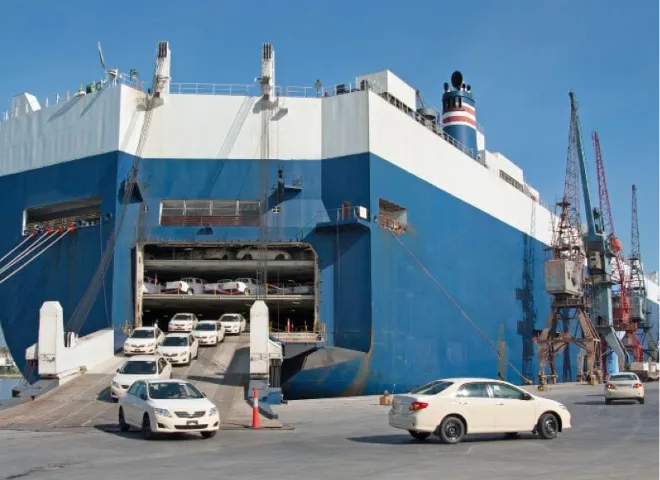
Conceptually, a RoRo vessel functions as a highly secure, multi-level mobile parking structure engineered for transoceanic voyages. These specialized vessels feature expansive cargo decks, adjustable internal ramp systems, and industrial-grade ventilation to safely manage vehicle exhaust emissions during loading and discharge operations.
When analyzing a modern maritime fleet, it becomes apparent that these vessels are constructed with high, fully enclosed superstructures. This design isolates the cargo from adverse meteorological conditions, saltwater exposure, and other environmental hazards during transit. Managing such complex maritime logistics requires extensive industry expertise. The operational lifecycle of these vessels is categorized into three critical phases.
Loading Process (Roll-on)
The loading phase operationalizes the "roll-on" capability. Vessels are equipped with heavy-duty ramps, predominantly positioned at the stern, with certain architectural variants incorporating side or bow ramps. These structures lower onto the terminal dock, establishing a secure transit corridor between the port infrastructure and the vessel's internal decks. Professional stevedores drive the vehicles, commercial fleets, or heavy machinery directly up the ramp and into designated stowage zones. The elimination of static crane lifting renders this loading sequence exceptionally rapid and systematically efficient.
Securing the Cargo
Upon reaching the designated stowage deck, meticulous securing protocols are implemented. Marine environments subject vessels to dynamic forces, including rolling and pitching. To guarantee structural integrity and cargo safety, all units are rigorously lashed to the deck infrastructure.
Decks contain thousands of reinforced lashing points. Stevedores utilize industrial straps, tensioners, and chains to anchor the chassis or wheels directly to the vessel. This secures the cargo against lateral or vertical shifting. Transporting specialized industrial freight demands vessels engineered for exceptional load-bearing capacities. For instance, a dedicated UGR Zakher Vessel integrates the structural reinforcements and heavy-duty lashing matrices required for massive industrial shipments. Furthermore, absolute adherence to operational terms and conditions guarantees that all international safety and compliance standards are verified prior to departure.
Unloading Process (Roll-off)
Upon docking at the destination terminal, the "roll-off" sequence is initiated, functioning as the inverse of the loading protocol. The vessel's ramps are deployed, lashing mechanisms are detached, and the cargo is driven directly off the ship into the port's primary holding facilities.
This immediate clearance protocol ensures rapid vessel turnaround and accelerates the final delivery phases for supply chain managers.
What Types of Cargo Can Be Shipped via RoRo?
A prevailing misconception limits this methodology to passenger automobiles. While it serves as the primary distribution channel for global automotive manufacturers, the structural capacity of these vessels accommodates a diverse spectrum of freight. Generally, any cargo equipped with wheels, or capable of being mobilized on wheeled platforms, qualifies for this transport method.
Standard cargo classifications include:
● Passenger Vehicles: Sedans, SUVs, and motorcycles.
● Commercial Transport: Fleet vans, heavy-duty trucks, passenger buses, and commercial coaches.
● Heavy Machinery: Construction assets (excavators, bulldozers), agricultural equipment, and mining infrastructure.
● Specialized Vehicles: Motorhomes, recreational trailers, and ATVs.
● Static Industrial Cargo: Oversized, non-wheeled industrial components, such as generators or turbines, are systematically loaded onto specialized wheeled platforms known as Mafi trailers, which are subsequently towed aboard the vessel.
The Advantages of RoRo Shipping
Integrating this methodology into international supply chains yields definitive operational and economic advantages for B2B enterprises and commercial shippers.
The primary advantage is operational velocity and efficiency. The drive-on/drive-off protocol exponentially reduces loading and discharge durations compared to containerized freight, which relies on sequential crane operations. This results in minimized port congestion and accelerated global transit times. Additionally, maintaining a predictable and transparent maritime schedule empowers enterprises to optimize their supply chain forecasting with absolute precision.
Secondly, the methodology delivers significant cost-efficiency. The reduction in port labor, crane utilization, and container stuffing/stripping processes translates directly to lower overall freight expenditures.
Furthermore, it ensures superior cargo security and risk mitigation. Vehicles are stowed within fully enclosed, climate-managed decks and individually secured. Unlike containerized shipping, where cargo is subjected to complex internal bracing, wheeled freight rests naturally on its engineered suspension systems. Integrating these structural advantages requires specialized maritime logistics solutions, such as comprehensive UGR Lines services, to ensure seamless global execution.
How to Prepare Your Vehicle for RoRo Shipping
For organizations and logistics coordinators planning to ship rolling stock, strict preparatory protocols are mandatory to ensure maritime compliance and operational safety. Standard industry preparation includes:
- Thorough Cleaning: Exterior and interior cleaning facilitates accurate pre-shipment condition reports and the documentation of any pre-existing exterior wear.
- Removal of Unsecured Items: Maritime regulations prohibit the stowage of unauthorized materials within the vehicle cabin during transit. The interior must remain completely empty, excluding factory-standard equipment such as spare tires.
- Mechanical Inspection: Vehicles must be inspected to ensure the absence of fluid leaks (oil, coolant, brake fluid). Port authorities will reject units that pose environmental or deck-hazard risks.
- Fuel Management: Vehicles must not be shipped with full fuel tanks. Industry standards dictate a maximum of 1/4 tank of fuel—sufficient only for terminal maneuvering.
- Electronic System Management: Anti-theft systems and alarms must be disabled to prevent battery depletion during the transoceanic voyage.
- Key Handover: Operational keys must be surrendered to the logistics provider to facilitate stevedore handling during port operations.
Is RoRo Right for You?
When architecting international logistics strategies, evaluating the structural and economic benefits of Roll-on/Roll-off transport is imperative. For the mobilization of commercial automotive fleets, heavy industrial machinery, or static cargo adaptable to Mafi trailers, this methodology represents the most efficient, secure, and economically viable transport solution.
By bypassing the financial and temporal costs of crane operations and containerization, it accelerates supply chain velocities and guarantees rapid deployment at the destination port. Staying informed regarding operational updates and maritime innovations through industry news is crucial for adapting to evolving global trade dynamics. For tailored maritime solutions and specific freight inquiries, utilizing a direct contact us channel ensures that complex logistical requirements are addressed with professional precision.